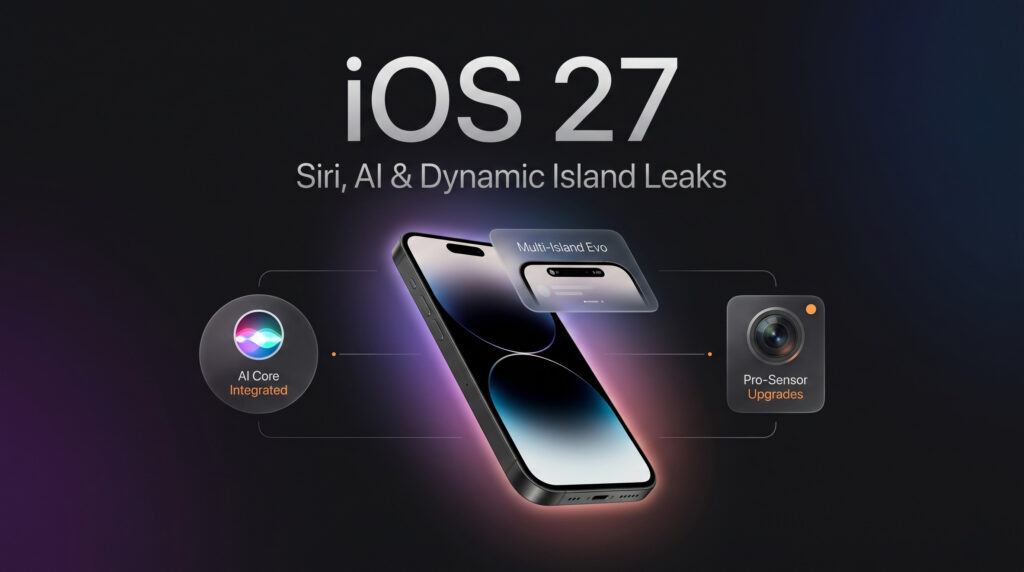
For the first time in years, the most interesting thing about an iPhone isn’t the hardware. It’s the software that’s about to land on it. iOS 27 hasn’t been announced yet, but thanks to a steady drumbeat of leaks in the weeks before WWDC, we already have a remarkably clear picture of what Apple is building. And it’s bigger than the usual round of refinements.
The headline is Siri. After years of being the assistant everyone quietly gave up on, Apple is rebuilding it from the ground up, handing it a dedicated app, a permanent home inside the Dynamic Island, and a brain borrowed from Google. Pair that with a Camera app that finally behaves like a real camera, and you have the most ambitious iPhone software update since the move to the modern Home Screen.
Here’s what the iOS 27 leaks actually say, why Apple is making these moves now, and what’s worth paying attention to when the company takes the stage.
What the iOS 27 Leak Actually Reveals
Most of what we know traces back to Bloomberg’s Mark Gurman, whose track record on Apple’s roadmap is about as good as it gets. Over the past few weeks his reporting has been joined by a wave of supporting iOS 27 leaks, backend code discoveries, and a fresh batch of illustrations that give us our first real look at the redesigned interface.
The renders aren’t official. As Bloomberg has been careful to note, these are visualizations based on what its sources have described, and Apple routinely tests several versions of a feature before settling on one. Still, the consistency across reports is striking. The same handful of changes keep surfacing, which usually means the picture is solid.
Strip away the noise and the iOS 27 rumored features break down into three big swings: a complete Siri redesign that lives in the Dynamic Island, a reworked Camera with pro-grade controls, and a philosophical shift toward letting outside AI models plug directly into the iPhone. Everything else, and there’s plenty, orbits around those three.
A Quick Reality Check Before WWDC
It’s worth keeping expectations grounded. Apple showed off a smarter, more personal Siri back at WWDC 2024, promoted it heavily in iPhone 16 ads, and then quietly delayed it. Apple later agreed to pay $250 million to settle a class action lawsuit accusing it of false advertising over the Siri features it promoted but didn’t ship on time.
That history matters. It explains both why Apple is swinging so hard this time and why a healthy dose of caution is warranted until features are actually in hand.
Why Apple Is Finally Redesigning Siri
To understand the scale of this iPhone update, you have to understand how far behind Siri fell. While ChatGPT, Gemini, and Claude turned conversational AI into something people use dozens of times a day, Apple’s assistant was still fumbling basic requests and punting most questions to a web search.
The most telling detail in the leak is what’s powering the new Apple Siri. According to Gurman, Apple has licensed Google’s Gemini models to run Siri after its own AI models proved inadequate. The rebuilt assistant reportedly runs on a custom Gemini-based model processed through Apple’s own Private Cloud Compute infrastructure rather than on Google’s servers directly. In plain terms, Apple swallowed its pride, rented a better engine, and wrapped it in its own privacy layer.
From Voice Command to Real Conversation
The clearest sign of the Siri redesign is the new standalone Siri app. The reporting describes an app that handles voice and text more like ChatGPT or Gemini, with persistent chat history, continuous dialogue, contextual memory, and multi-step reasoning, so you can ask follow-up questions without starting over each time.
There’s an “Ask Siri” text field at the bottom, a microphone for voice, and a paperclip for attaching images and files. A separate view keeps a running list of past conversations. If you’ve used a modern AI assistant, the layout will feel immediately familiar, which is rather the point.
Smarter Answers, Fewer Detours to Safari
The other big change is how the new Apple AI assistant handles information. Where today’s Siri often bounces you out to Safari, the new version is said to pull answers from the web directly and present them with structured data, bullet points, and images inside the Siri interface itself. That’s the difference between an assistant that points at answers and one that actually gives them.
How the Dynamic Island Could Expand in iOS 27
If the Siri app is the showpiece, the Dynamic Island is where the redesign quietly becomes part of your everyday muscle memory. This is the change I find most clever, because it reframes a feature that has mostly been used for music controls and timers.
Siri Lives in the Pill Now
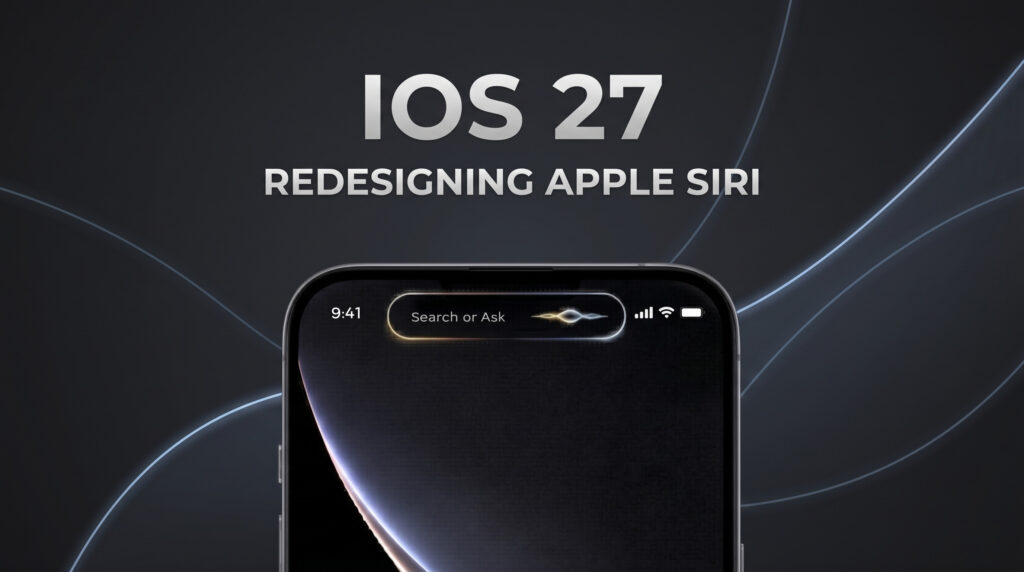
Instead of the full-screen blur or floating orb you get today, the new Siri triggers a responsive animation that pops out of and expands within the Dynamic Island, keeping whatever you’re doing visible while it works in the background. In the leaked renders, Siri essentially becomes an always-on agent that resides in the Island itself.
It’s a subtle shift with a big payoff. Asking a quick question stops being a disruptive, screen-hijacking event and becomes something closer to glancing at a notification. This kind of Dynamic Island customization is exactly the sort of thing that doesn’t demo as flashy but changes how the phone feels in daily use.
The New “Search or Ask” Gesture
There’s a new way in, too. iOS 27 users will reportedly be able to swipe down from the top center of the screen anywhere to launch a “Search or Ask” interface, with results appearing in a rich text card that pulls out of the Dynamic Island; swipe down further and the full conversation opens. The classic triggers stick around, so saying “Siri” or holding the power button still works.
Read between the lines and this looks like Apple turning Siri into a system-wide layer that increasingly replaces traditional Spotlight search. The assistant stops being a feature you summon and starts being the front door to the whole device.
A Darker, Quieter Look
The visual language is changing as well. The interface Apple is testing uses an all-dark color scheme with no light mode for now, accented with soft pink, dark blue, purple, and orange highlights, and Gurman notes Apple’s WWDC promotional artwork uses those same colors as a deliberate tease. The branding and the product are being designed to match, which tells you how central this is to Apple’s story this year.
The iOS 27 Camera Overhaul Nobody Saw Coming
Not everything in iOS 27 is about AI, and honestly, the Apple camera overhaul might be the change that delights the most people day to day. The stock Camera app has always been great at point-and-shoot and frustrating the moment you wanted real control. That’s finally changing.
Pro Controls, Finally
Gurman reports that controls like flash, exposure, the timer, depth-of-field, photo styles, and resolution will become movable widgets you can pick and arrange yourself, with a transparent tray sliding up from the bottom and options sorted into basic, manual, and settings groups. Each shooting mode gets its own independent layout, so your photo setup stays separate from video, and if you never touch any of it, the app opens exactly as it does today.
That last detail is the smart part. Apple is giving power users a deep, customizable interface without scaring off the millions of people who just want to tap the shutter. The direction got a lot clearer when Apple hired Sebastiaan de With, co-founder of the well-regarded manual camera app Halide, a move that signals Apple intends to absorb the kind of fine-grained controls photographers used to pay third-party developers for.
Siri Comes to the Viewfinder
The camera is also where Siri AI integration gets genuinely practical. A new Siri mode inside the Camera taps into Visual Intelligence, so you can point at a plant or a sign in another language and get an answer in real time. It sits alongside the existing Photo and Video modes, and when active, the shutter button carries the Apple Intelligence logo to signal you’re in Siri mode.
For a feature most people never knew existed, folding it directly into the viewfinder could finally make Visual Intelligence something you actually reach for.
New AI Editing Tools, With a Caveat
The Photos app is picking up new tricks as well. Three AI editing tools are reportedly joining the existing Clean Up feature: Extend, which generates content beyond a photo’s original frame, Enhance for smart auto-corrections, and Reframe, which shifts perspective on spatial photos.
But here’s the honest caveat. Gurman has flagged that Extend and Reframe don’t perform reliably yet, raising the possibility they get delayed or scaled back, potentially pushed to a later beta or an iOS 27.1-style update rather than the initial release. File those two under “believe it when you see it.”
How Apple AI Could Take On ChatGPT and Gemini
The most fascinating part of this Apple software overhaul isn’t any single feature. It’s a change in philosophy. For fifteen years, Apple treated openness as a risk. iOS 27 suggests it has decided it can’t win the AI race entirely on its own.
Bringing In Outside Models
Apple is reportedly introducing an “Extensions” framework that lets you route complex queries to external models like Google Gemini, OpenAI’s ChatGPT, or Anthropic’s Claude right inside the native interface. According to one report, these third-party agents would be swappable AI backends accessible through a dedicated App Store section, with a long-press on the Siri search bar letting you switch models entirely.
Think about what that means. The iPhone’s built-in assistant handles the everyday stuff, but when you hit something it can’t, you hand the request to a heavyweight model without ever leaving the screen. It’s a quiet admission that no single assistant wins every task, and it could reshape how people interact with the broader Apple ecosystem.
Competing by Not Competing Alone
There’s a real strategy here. Gurman frames the redesigned Siri as a full chatbot built to compete with ChatGPT, Claude, and Gemini. By licensing Gemini for the foundation and opening the door to rivals as extensions, Apple gets to ship credible iPhone AI features now while keeping its own privacy-first framing intact.
Whether developers actually build compelling extensions, or whether the framework becomes another neglected corner of the App Store, is the open question. But the architecture at least acknowledges reality, and that’s more than Apple’s AI efforts have managed lately.
What Apple Might Announce at WWDC
All of this points to one date. Apple has confirmed its WWDC 2026 keynote for June 8 at 10 a.m. Pacific, with the conference running through June 12 and developer betas expected the same day as the keynote. The Apple WWDC leaks all line up on a single theme: this is going to be an AI show.
Expect Siri to be the centerpiece, with the Dynamic Island integration, the standalone app, and the Gemini-powered brain front and center. The Camera overhaul should get stage time too, given how broadly appealing it is. Beyond the headliners, the leaks point to smaller touches across the next iOS update, including a redesigned Safari start page, a Weather app that surfaces more data at a glance, and Apple’s Liquid Glass design language spreading further through the system.
One thing to temper expectations: not every leaked feature will necessarily ship on day one, and Apple’s recent Siri history means the company is under real pressure to deliver exactly what it shows. After last time, “we really mean it” only counts if the thing actually works.
The Bottom Line: A Make-or-Break iPhone Update
iOS 27 is shaping up to be the most consequential iPhone software update in years, and the stakes feel higher than usual. Apple isn’t just adding features. It’s trying to rebuild trust in an assistant it has publicly fumbled, while quietly admitting it needs help from the very rivals it spent years keeping at arm’s length.
If the new Apple Siri app delivers, the Dynamic Island becomes the natural home for an assistant you actually use, the Camera finally satisfies serious shooters, and the iPhone’s AI story stops being an apology. If it stumbles, this becomes another chapter in a saga Apple badly needs to end.
We’ll get our first official answers on June 8, with a public release expected in the fall alongside the next iPhone lineup. Until then, treat the renders as a preview, not a promise. The ambition is clearly there. Now Apple just has to ship it.