

Marketing teams have a known problem. Customer data sits in one tool, creative assets in another, journey logic in a third, analytics in a fourth, and approvals scattered across email and Slack. Running a single campaign means jumping between five dashboards and chasing sign-offs for a week. Adobe’s pitch with CX Enterprise is that an AI agent platform can collapse that into a goal you state once and a workflow that runs itself.
The Adobe CX Enterprise AI agent platform launched at Adobe Summit on April 20, with general availability in the next few months. It’s a serious play. I covered the surface-level announcements in our broader look at Adobe’s AI agent push, but the CX side deserves its own breakdown because the architecture is genuinely different from most enterprise AI tools right now.
What Is the Adobe CX Enterprise AI Agent Platform?
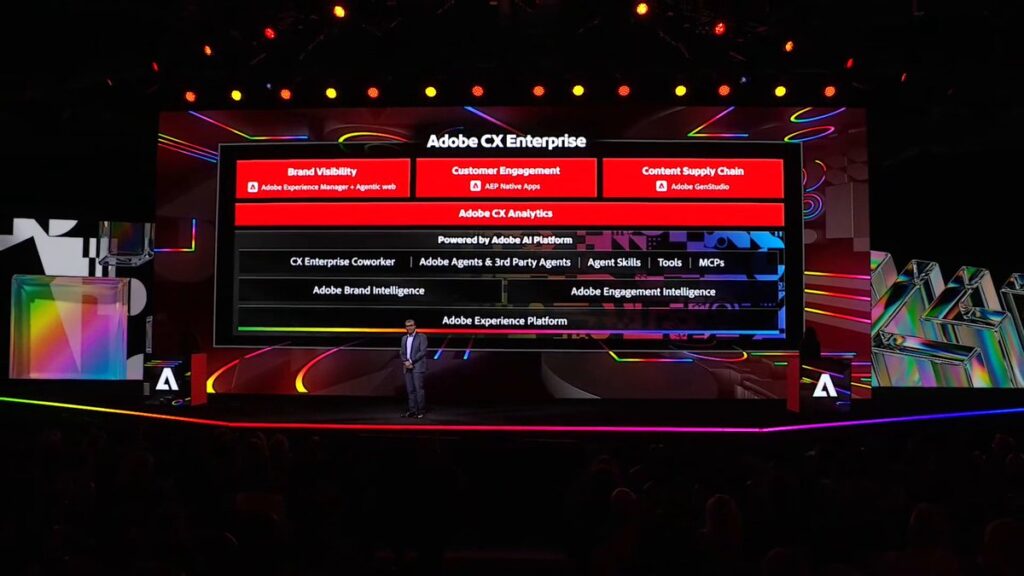
CX Enterprise is an end-to-end agentic AI system built for the full customer lifecycle. Acquisition, engagement, conversion, retention. Adobe describes it as bringing together AI agents, agent skills, and Model Context Protocol endpoints under one intelligence and governance layer. Here’s the practical version.
The Three Layers
Agents are the things that do specific jobs (Audience Agent, Journey Agent, Marketing Agent). Agent skills are reusable workflow templates so teams aren’t building from scratch every time. MCP endpoints are the connection points that let these agents talk to other systems, including non-Adobe ones. That last part is the one people miss. Adobe didn’t build a closed system.
How CX Coworker Fits In
CX Enterprise Coworker is the orchestration layer on top. Adobe calls it the team captain, which is a fair analogy. Individual agents do single tasks then shut down. Coworker has persistent agency, meaning marketing leaders set the goal once and Coworker keeps coordinating agents toward that goal over time. It pulls audiences, activates creative, sequences journeys, monitors performance, and adjusts based on what’s working.
You’re not asking it to write copy. You’re telling it to hit a number.
How Does CX Enterprise Coworker Actually Work?
The example Adobe uses everywhere, and it’s worth walking through. A marketing team wants a 3 percent lift in cross-sell performance for an existing product line.
You define the goal and parameters. Coworker reads the request, then pulls the right data and assembles a plan. It identifies eligible audiences using Real-Time CDP, surfaces relevant creative assets, drafts the journey logic in Journey Optimizer, and projects expected results from Customer Journey Analytics. Then it waits for human sign-off.
Once approved, Coworker launches the campaign and tracks the 3 percent target in real time. If a segment underperforms, it can resequence steps, swap content, or shift budget within the parameters you set. If something falls outside the guardrails, it kicks the decision back to a human. The agent doesn’t run wild.
The whole loop replaces what is currently three weeks of meetings, dashboards, briefs, and approval chains. At least in theory.
Agent Orchestrator and the Open Standards Bet
This is the part that surprised me. Adobe didn’t build a walled garden.
Why MCP and A2A Matter
CX Enterprise is built on Model Context Protocol and Agent2Agent, the open standards that let AI systems share context and coordinate across vendors. As CX Today noted, this is a deliberate competitive move. Salesforce and Microsoft mostly keep their AI inside their own ecosystems. Adobe is doing the opposite. The Experience Platform Agent Orchestrator coordinates agents across Adobe’s stack and third-party platforms in the same workflow.
Most enterprises already run a mixed stack. They’re not ripping out Salesforce CRM or Microsoft 365 to standardize on Adobe. So Adobe is trying to be the orchestration layer instead of another silo.
Marketing Agent Inside Other Chatbots
Adobe’s Marketing Agent is now in Microsoft 365 Copilot, with beta access in ChatGPT Enterprise, Claude Enterprise, Gemini Enterprise, IBM watsonx Orchestrate, and Amazon Q. A marketer working in Copilot can invoke Adobe agents without leaving the tool. Adobe announced 30+ AI partner integrations at Summit, including AWS, Anthropic, Google Cloud, NVIDIA, and OpenAI.
The Data and Governance Backbone
The platform pulls intelligence from Real-Time CDP, Customer Journey Analytics, Journey Optimizer, Marketo Engage, and Target. Adobe’s Experience Platform handles more than 1 trillion customer interactions a year across 20,000 brands, so the data foundation is already there. The agents have decades of Adobe’s domain expertise baked in.
For regulated industries, Adobe partnered with NVIDIA to integrate OpenShell secure runtime and Nemotron open models. That gives healthcare, finance, and government buyers a governance layer they can pass compliance reviews with. Auditability is the part most enterprise AI tools are quietly bad at, and Adobe is making it a selling point.
Who Is This Actually For?
Honestly, large enterprise marketing teams already running Adobe Experience Cloud. The integrations, the data backbone, and the agent orchestration only really pay off if you’re already deep in the stack and producing enough campaign volume that automation matters.
For mid-market teams, it’s a wait-and-see. CX Coworker is powerful, but the value depends on having the underlying Adobe data infrastructure to feed it. If you’re running HubSpot, Klaviyo, or a mixed stack, you’re not the buyer right now. That said, the open standards approach means you might benefit indirectly through the Marketing Agent inside Copilot or Claude. Worth experimenting with marketing workflow setups before committing to a platform shift.
Final Take
The Adobe CX Enterprise AI agent platform is one of the more thoughtfully designed enterprise AI launches I’ve seen this year. CX Coworker as the orchestration layer, MCP and A2A as the open foundation, and a real data backbone underneath. Execution will take time to mature and the price point will be enterprise-only, but the architecture is sound.
For a wider view, our breakdown of Firefly and Adobe’s broader AI agent strategy covers the rest, and AI tools we’ve actually tested is a good next read.