
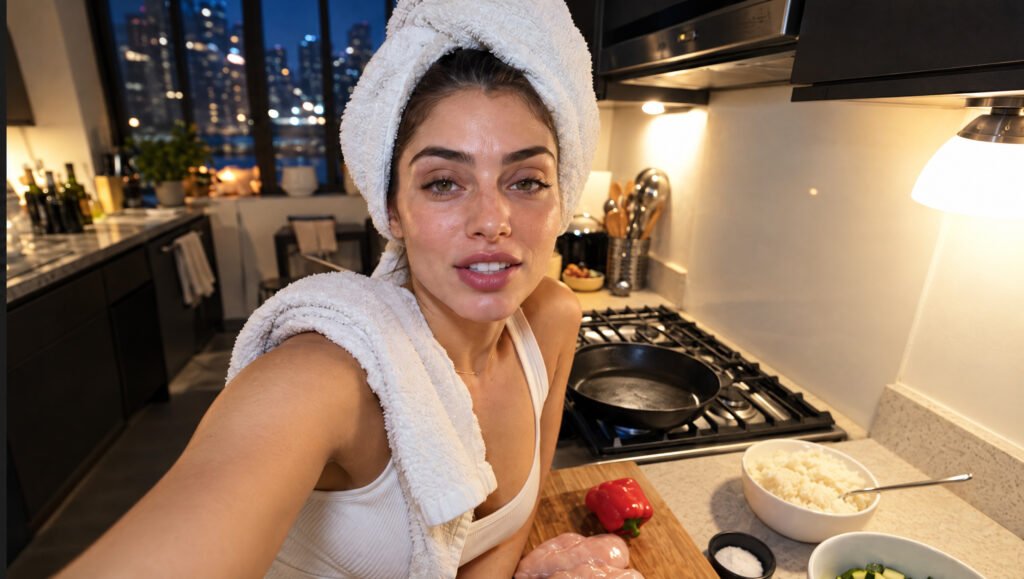
If you want to make a realistic AI vlog with Seedance 2.5 in Higgsfield, the biggest thing is not just the model. It is the setup. I was surprised by how much better the result gets when you stop treating it like a random AI video prompt and start building it like a proper character-driven scene. That means creating the person first, locking the face, then writing the video around continuity, camera behavior, lighting, and believable action.
In this workflow, I am making a realistic AI cooking vlog that feels like a real late-night fitness influencer video, not polished AI slop. The process is simple:
- Generate the character in GPT Image 2.5 Sunburst
- Turn that into a consistent character sheet
- Use both references in Seedance 2.5 / Higgsfield AI
- Generate a realistic AI video that feels handheld, warm, and believable
If you have been wondering how to make an AI video that actually looks real, this is where I would start.
Why most realistic AI videos still feel fake
A lot of so-called realistic AI videos still break in obvious ways. The face changes. The body changes. The food jumps backward in time. Hands melt. Camera moves feel too perfect. Or everything looks like a glossy ad instead of a person casually filming on a phone.
That said, the fix is not complicated. You need to control a few things properly:
- one clear character identity
- one stable outfit and environment
- one logical action progression
- imperfect camera behavior
- real-world lighting
- strong continuity rules
This is where Seedance 2.5 gets interesting. It is strong enough to create motion that feels natural, but only if the prompt is doing real work.
Step 1: Generate the kitchen character in GPT Image 2.5 Sunburst
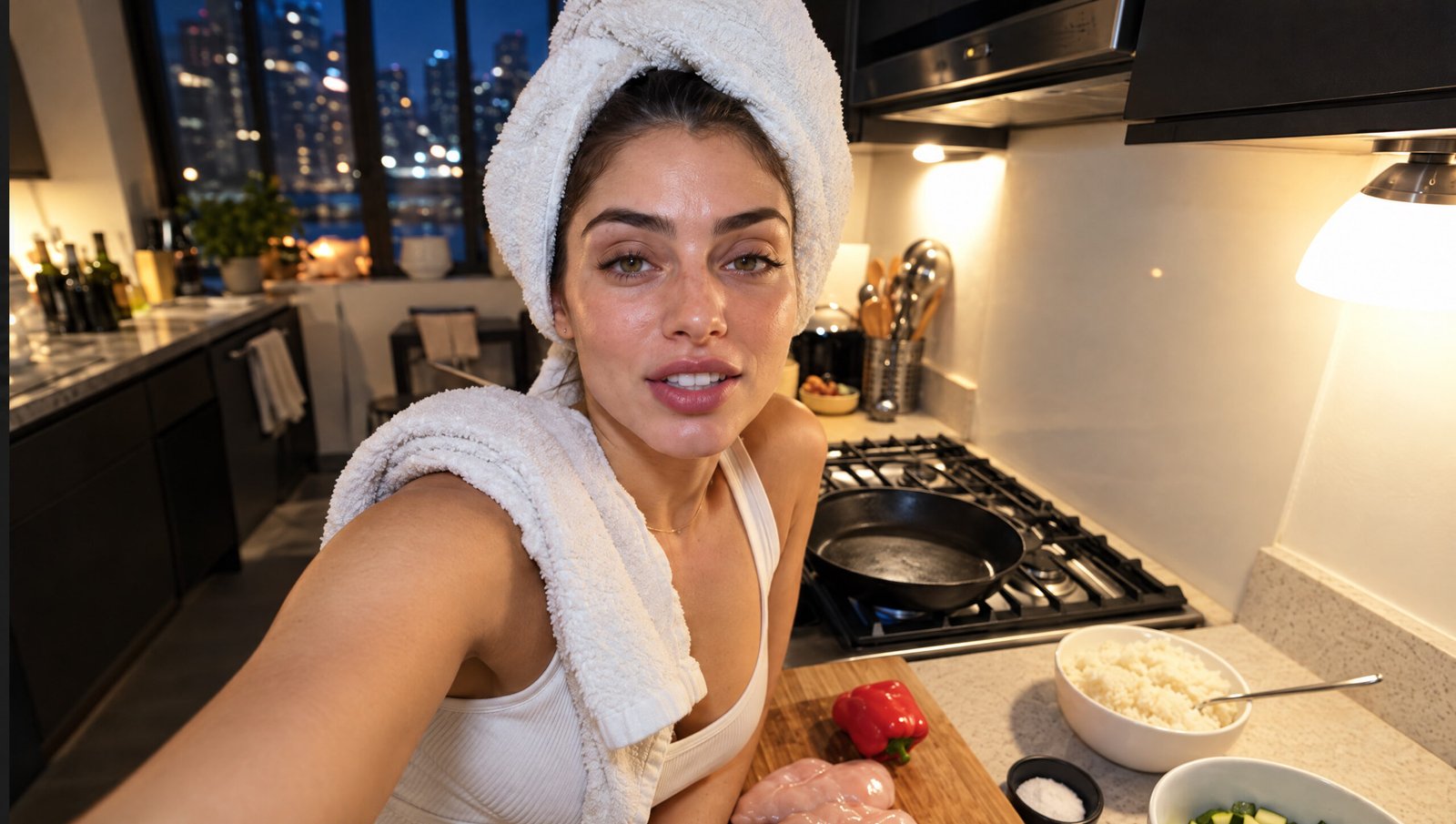
First, create the woman who will carry the whole vlog. This matters a lot, because if the first image does not feel believable, the final video usually does not either.
The goal here is simple: make a character that already looks like a frame pulled from a real smartphone video.
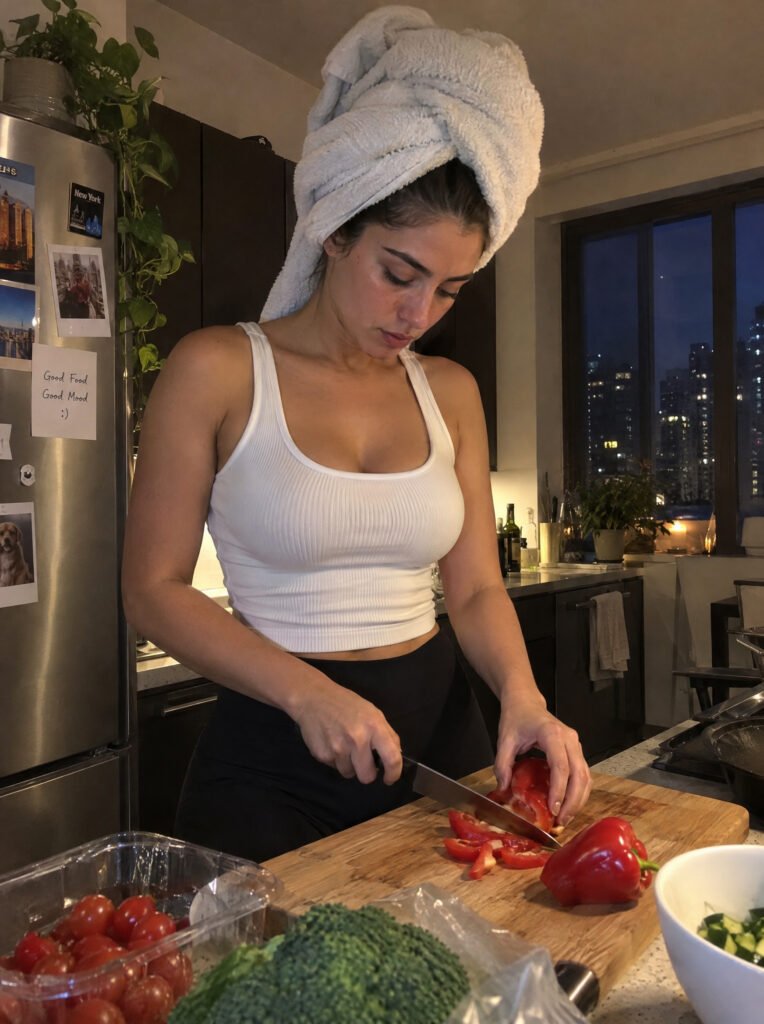
Prompt: Kitchen character image
A photorealistic candid smartphone video frame of an exceptionally beautiful 25-year-old woman casually preparing food in her apartment kitchen at night. She has a naturally stunning feminine face, soft symmetrical facial features, captivating almond-shaped hazel eyes, full natural lips, defined cheekbones, a delicate nose, glowing olive skin, and a relaxed, slightly sleepy expression. Effortlessly gorgeous, with the natural beauty of a fitness and lifestyle influencer, but completely believable as a real person.

She has a fit, naturally curvy feminine physique, a slim waist, toned arms, and realistic body proportions. Wearing a fitted white ribbed athletic tank top and black high-waisted workout leggings. Her freshly washed dark brown hair is wrapped in a thick white bath towel.

Standing at a wooden kitchen countertop, leaning slightly forward while slicing a bright red bell pepper with a kitchen knife. Her eyes are looking down at the vegetables, completely unaware of the camera. Natural posture, realistic hands, subtle body movement implied.

CAMERA: Low countertop-level smartphone camera angle, slightly wide 26mm equivalent lens, medium shot showing her head, torso, hips, hands, and cutting board. Intimate casual home-video framing, slightly imperfect composition, as if a phone was casually placed against a kitchen appliance.

LIGHTING: Dim warm apartment kitchen lighting, cool blue evening light through the window, natural shadows across her face and body, subtle digital sensor noise, realistic skin texture, slight compression artifacts.

A lived-in modern apartment kitchen with small magnets on the refrigerator, cooking utensils, vegetables, dark cabinets, and casual everyday clutter.

Authentic unfiltered Instagram story screenshot aesthetic, believable amateur photography, natural skin pores, realistic anatomy, no beauty filters, no commercial studio lighting, no cinematic color grading, no artificial glamour poses. Extremely realistic candid moment.
What worked well here
What worked well is that this prompt is not trying too hard. It is descriptive, but still grounded. It tells the model exactly what matters:
- candid smartphone feel
- believable influencer-level beauty without looking fake
- natural kitchen clutter
- realistic skin texture
- slightly imperfect framing
- warm indoor light mixed with cool night light
That combination is what helps push the result closer to ai videos that look real later on.
Step 2: Build a 6-panel character sheet for consistency
Once the hero image is ready, the next step is character locking. This is one of the best things you can do if you want a realistic AI video instead of a face-changing mess.
The purpose of the sheet is to give Seedance 2.5 a stronger identity anchor from multiple angles.
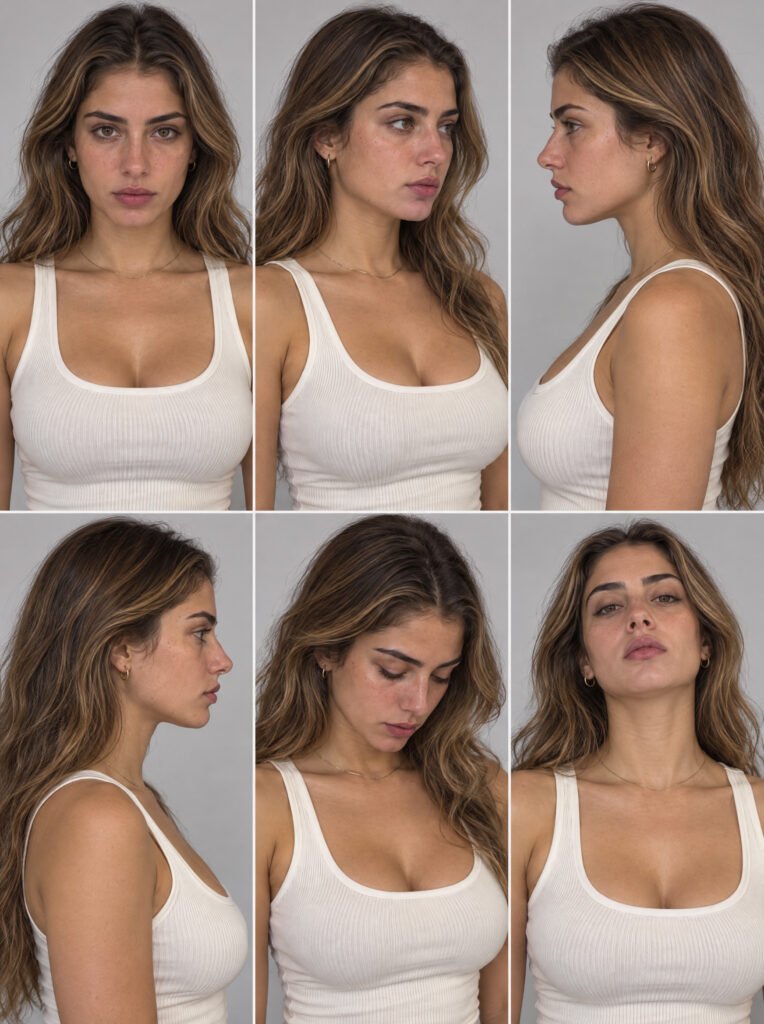
Prompt: Character sheet
Use the first generated image as the reference.
Photoreal 6-panel character reference sheet of the same young woman in her early twenties, 2 rows of 3 on a seamless light-grey background. Panels: front, three-quarter left, profile left, profile right, three-quarter looking down, chin raised. Long layered loose-wave light-brown hair with honey-caramel sun streaks and a center part, pale grey-green eyes, light freckles across the nose and cheeks, thick natural straight brows, full soft-pink lips, bare skin with no makeup, small gold hoops, fine gold chain, cream ribbed tank top. Even soft studio light, real skin texture with visible pores, the same face 100% consistent in all 6 panels, no text.
Why this step matters
For most people, this is going to be more than enough to improve consistency. A good character sheet helps with:
- face consistency across cuts
- cleaner profile and 3/4 angles
- more stable eye shape and skin tone
- fewer identity drifts during motion
- better continuity in selfie-style shots
If your goal is making one of those most realistic AI videos, skipping this step is usually where things start to break.
Step 3: Use both references in Seedance 2.5 / Higgsfield AI
Now comes the main part. This is where the scene becomes an actual realistic AI vlog.
You will use:
- the original kitchen image
- the 6-panel character sheet
The first image gives the model the look and environment. The character sheet helps hold identity together when the camera moves.
Prompt: Seedance 2.5 / Higgsfield AI video prompt
Handheld digital camcorder aesthetic, landscape framing.
A gorgeous fitness and food influencer films herself by hand in selfie-cam and first-person style while cooking a late-night high-protein meal after training and a shower.

Keep realistic hand shake, slightly crooked framing, autofocus briefly hunting between her face and the food, awkward zoom-ins onto the pan, occasional motion blur, brief lens steam-up over the hot pan that clears naturally, and small framing mistakes where her face or the pan edge slips out of frame.

Mix handheld selfie footage with a few fixed external shots.
Important: never show her placing, adjusting, or setting up a camera.
When switching from handheld footage to a fixed external angle, use a clean jump cut as if the camera had already been positioned before the shot began.
The camera itself must never appear on screen or in the window reflection.

LOOK:
Warm late-night kitchen light.
A single warm pendant over the counter, cool blue night visible through the window behind her, under-cabinet strip light glowing on the backsplash.
Slight camcorder softness, faint noise in the shadows, mild bloom on the pendant.

Food realism is the core of the look: real sizzle with fine oil spatter, steam rising and curling from the pan, honest food textures with sear marks and glistening surfaces, knife cuts that separate cleanly, droplets on rinsed vegetables.
Realistic skin texture, fresh-from-the-shower glow, clean dewy skin, realistic skin tones.

STYLE:
A realistic late-night what-I-eat-after-training vlog.
The tone is relaxed, hungry, funny, quietly confident, and natural, talking to the lens like a friend while her hands keep working.
She is clearly attractive and charismatic, but the video must feel like a believable self-recorded kitchen vlog, not a food commercial.
Fast clean jump cuts, strong continuity, natural body language, real kitchen sounds, sizzle, chopping, no awkward dead moments.

CHARACTER:
The woman in the reference image. Her face, features, skin tone, body, and clothing must match the reference image exactly in every shot — she wears exactly what she is wearing in the reference image. Do not restyle, beautify, or alter her in any way beyond the reference.
The one addition: a soft white towel wrapped around her head like a turban, as if she just stepped out of the shower. The towel stays neatly wrapped for the whole video. A few small damp strands of hair may peek out at the hairline and neck.
Minimal or no makeup, fresh clean post-shower look.
A small kitchen towel over one shoulder for most of the video.

SETTING:
A small warm real apartment kitchen at night.
Wooden counter with knife marks, a gas hob with one cast-iron pan, a cutting board with chicken breast and vegetables, a bowl of cooked rice, a bottle of olive oil, salt in a small dish, a fridge with magnets and photos, dishes drying on a rack, dark window over the sink reflecting the warm kitchen.
Lived-in and slightly cluttered.
No other people, no pets.

IMPORTANT CONTINUITY RULES:
The same woman from the reference image must remain fully consistent in every shot.
No face changes, no outfit changes, no body changes.
The head towel stays wrapped in the same position in every shot — it never unwraps, falls, changes color, or disappears.
The meal progresses in one direction only: raw ingredients, then chopping, then searing, then plating, then eating, and never reverses or regenerates.
Food already cooked never becomes raw again.
Hands and knife are the top priority: five fingers always, correct knife grip with curled guiding fingers, clean cuts, the knife never bends and never passes through her hand.
The pan, board, oil bottle and rice bowl stay in the same positions.
Steam and sizzle must behave with real physics.
No extra people, including in the dark window reflection, and the reflection never shows a camera.
No duplicated limbs.
No camera visible.
No camera setup shown.
Keep her matching the reference image, warm, and photogenic in every shot.

STORYBOARD:
30 seconds total, 10 cuts.

(~3s, arm's-length selfie)
She leans on the counter, towel wrapped on her head, clearly fresh from the shower after training, and grins tiredly at the lens.
Dialogue:
"Trained late. Showered. Starving. Let's cook."

(~3s, handheld pan across the counter and back to her)
The camera drifts across the board with raw chicken and vegetables, the pan, the rice bowl, then back up to her face.
Dialogue:
"Ten minute meal. Watch."

(~3s, fixed external medium shot from across the counter)
Jump cut.
She is already chopping a red pepper with quick confident cuts, guiding fingers curled, pieces falling evenly.
No camera setup shown.
No dialogue, just the knife on the board.

(~3s, same fixed shot)
She slices the chicken breast into strips, seasons it from the salt dish with a high pinch, and rubs it in with her fingertips.
Dialogue:
"Protein first. Always."

(~3s, tight handheld first-person shot over the pan)
Oil shimmering, she lays the chicken strips in one by one and they hit with a loud real sizzle, fine spatter, steam rising into the lens which fogs for a beat and clears.
No dialogue, just the sizzle.

(~3s, handheld selfie while the pan sizzles behind her)
She turns the camera on herself, fanning steam away from her face, laughing, one hand briefly steadying the head towel.
Dialogue:
"The smell. You have no idea."

(~3s, tight handheld close-up of the pan)
She flips the strips with tongs, showing deep golden sear marks, tosses in the peppers, and shakes the pan once so everything jumps and resettles.
Dialogue:
"That colour? That's the whole point."

(~3s, fixed external shot)
Jump cut.
She plates it: rice pressed from the bowl, chicken and peppers over the top, a last drizzle of olive oil in a thin ribbon, and she wipes the plate rim with the towel like a chef, then smirks at her own seriousness.
Dialogue:
"Yes, I wiped the rim. Let me live."

(~3s, tight handheld close-up)
First fork bite, steam still coming off it, she chews, closes her eyes for a beat and nods slowly.
Dialogue:
"Ten minutes. That's it. Ridiculous."

(~3s, arm's-length selfie ending)
Plate in one hand, camera in the other, she backs out of the kitchen toward the sofa, flicking the kitchen light off with her elbow.
Dialogue:
"Okay. Eating. Good night."

FINAL INSTRUCTION:
The result must feel like a real self-recorded late-night cooking vlog by an athlete who actually cooks, filmed right after her shower.
The highest priorities are matching the reference image exactly, correct hands and knife work at close range, one-directional cooking progression that never reverses, real sizzle, steam and food texture, the head towel staying consistently wrapped, honest warm kitchen light against the dark window, and subtle imperfection.
Keep it warm, hungry, and real.
Not a food commercial, not overhead recipe content, not stiff.
Why this prompt works better than a generic AI video prompt
This is where a lot of people go wrong. They write one short sentence like “make a girl cooking in the kitchen” and expect magic. That is not enough if your goal is a realistic ai video.
This prompt works because it locks down:
1. Character consistency
The face, body, styling, towel, and clothes are all pinned.
2. Camera realism
The camera is not too perfect. That matters. Slight shake, autofocus hunting, awkward zooms, steam on the lens — these little things sell the realism.
3. Physical continuity
The food progression only moves forward. That sounds small, but it stops the classic AI problem where cooked food randomly becomes raw again.
4. Environment logic
The kitchen is defined enough to feel stable without becoming overdesigned.
5. Performance tone
She sounds like a real person who is hungry after training, not a scripted commercial actor.
Honestly, this is where Higgsfield AI can look really strong when the prompt is built with actual intent.
What to do if the result still feels fake
Even with a good setup, you may need a few tries. In my testing, the biggest issues usually come from one of these:
Face drift
If the face changes too much, strengthen the character sheet or simplify the styling.
Overly cinematic look
If it looks too polished, remove glam words and push more “candid,” “casual,” and “unfiltered” language.
Bad hands or knife work
Increase the hand instructions and keep those action shots shorter.
Food losing realism
Push food physics harder: steam, sear marks, oil spatter, clean knife cuts, cooked progression.
Camera looks too stable
Add more wording around slight shake, framing mistakes, autofocus breathing, and motion blur.
That said, when the structure is right, Seedance 2.5 can give you some of the strongest ai video examples for casual influencer-style content.
Is Seedance 2.5 good for realistic AI videos?
Yes especially if your goal is social-style content rather than glossy commercial work.
I can see why people are starting to use it more for creator workflows. It handles motion better when the scene is grounded in believable activity, and it works especially well when you already have a solid visual reference. That is why the GPT Image 2.5 Sunburst stage matters so much here.
If you are trying to make ai videos that look real, this pipeline makes more sense than jumping straight into video with no visual foundation.
FAQ
What is the best way to make a realistic AI vlog?
The best way is to build it in layers. First create the character, then create a character sheet, then generate the video with strict continuity and camera rules. That approach works much better than one loose text-only prompt.
Is Higgsfield AI good for realistic videos?
Yes, especially for creator-style content. It works well for selfie clips, lifestyle scenes, and vlog-style videos when the prompt is detailed and reference images are strong.
Why do AI videos still look fake?
Usually because of inconsistent identity, overly clean motion, unrealistic hands, or poor continuity. Most fake-looking results are prompt structure problems, not just model problems.
How do you make AI videos look real?
Use believable lighting, imperfect framing, real-world scene clutter, stable identity, logical action progression, and natural physical details like steam, motion blur, and autofocus shifts.
Can Seedance 2.5 make realistic AI cooking videos?
Yes. Cooking scenes work especially well because they give the model clear physical actions, food progression, steam, and texture — all of which help sell realism.
Final thoughts
If your goal is to make a realistic AI vlog with Seedance 2.5 and Higgsfield, I would not overcomplicate it. The main win here is building the right foundation. First lock the character. Next lock the angles. Then give the video prompt enough structure to behave like a real scene instead of a vague AI guess.
What surprised me most is that this kind of workflow does not just improve quality — it makes the output feel intentional. And that is the difference between random AI clips and realistic AI videos people actually stop and watch.
That’s it. Subscribe for more prompts.

One Response