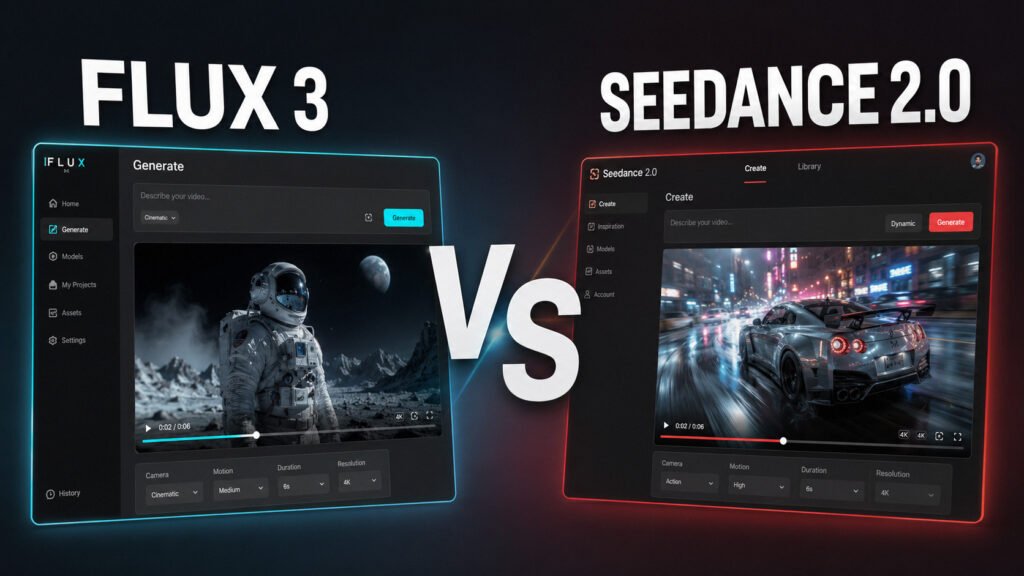
FLUX 3 vs Seedance 2.0 is already becoming one of the most important AI video comparisons of 2026. Black Forest Labs has entered early access with video generation up to 20 seconds, native audio, multilingual dialogue, visual references, and a planned open-weight model. Seedance 2.0 is already available with strong multimodal control, synchronized audio, video editing, and 15-second multi-shot generation.
So, has FLUX 3 already dethroned Seedance 2.0? Not yet. Black Forest Labs reported a narrow preference win in its own preliminary evaluation, but wider independent testing is still missing. Right now, FLUX 3 looks like the more ambitious platform, while Seedance 2.0 remains the more established tool for creators who need a documented production workflow today.
FLUX 3 vs Seedance 2.0: Quick comparison
| Feature | FLUX 3 | Seedance 2.0 |
|---|---|---|
| Current status | Early access | Officially launched |
| Maximum stated clip length | Up to 20 seconds | Up to 15 seconds |
| Native audio | Yes | Yes, including dual-channel audio |
| Supported references | Images, video, and video-audio continuation | Text, images, video, and audio |
| Editing capabilities | Video-to-video, continuation, and keyframe-to-video | Targeted editing and video extension |
| Open weights | Planned through FLUX 3 Dev | No equivalent open-weight model announced |
| Best fit today | Early adopters, developers, and experimental studios | Creators wanting a more mature workflow |
The basic comparison looks close, but the two models are at different stages. Seedance 2.0 is a released creative product. FLUX 3 is still being rolled out through early access, with several parts of the wider model family planned for the coming weeks and months.
What makes FLUX 3 a serious Seedance challenger?
FLUX 3 is not simply another image model with video added as a separate feature. Black Forest Labs describes it as a unified multimodal foundation model trained across images, video, and audio. The goal is to help one system learn how scenes look, how objects move, and how physical events sound.
According to the official FLUX 3 announcement, the video model supports:
- Text-to-video generation with native audio
- Image-to-video animation and visual references
- Video-to-video generation from a reference clip
- Generative video and audio continuation
- Keyframe-to-video transitions
- Multilingual dialogue
- Multiple aspect ratios and visual styles
- Animated typography and motion design
- Chaining clips into longer multi-shot sequences
The headline feature is generation up to 20 seconds in one pass. That gives FLUX 3 a longer stated single-generation limit than Seedance 2.0’s 15-second output. Still, length alone does not decide quality. A 20-second clip only helps when the subject, motion, composition, dialogue, and sound remain stable throughout the sequence.
The wider roadmap may matter even more. Black Forest Labs plans API and private-weight access for FLUX 3 Video, a separate FLUX 3 Image release, action-prediction tools, and an open-weight FLUX 3 Dev backbone. That could make the system attractive to developers and studios building private or customized workflows.
Why Seedance 2.0 is still difficult to beat
Seedance 2.0 has one major advantage: creators can already judge a clearly defined workflow. ByteDance built it around a unified audio-video architecture that accepts text, images, video, and audio as references.
The official Seedance 2.0 launch announcement says users can combine up to nine images, three video clips, three audio clips, and natural-language instructions. The model can use these materials to guide composition, motion, camera movement, visual effects, and sound.
This makes Seedance 2.0 feel less like a basic prompt box and more like a compact directing system. A creator can provide a character image, a movement reference, an environment, an audio sample, and a written instruction, then ask the model to bring those elements together in one sequence.
Seedance 2.0 focuses heavily on creative control
ByteDance highlights complex motion, multi-subject interaction, physical accuracy, camera planning, subject consistency, targeted editing, and video extension. It also supports 15-second multi-shot audio-video output.
That matters in a real production workflow. A visually impressive clip is useful, but creators normally need repeatable control. They need the same character across shots, the right camera movement, predictable timing, and the ability to revise one part without rebuilding the complete scene.
Its audio workflow is already well defined
Seedance 2.0 supports dual-channel audio and parallel output for dialogue, background music, ambient effects, and character voiceovers. ByteDance says these elements can be aligned with the rhythm and action of the video.
The company also acknowledges that the model still has weaknesses. Its own launch material notes occasional audio distortion and room for improvement in multi-subject consistency, text rendering, and complex editing. That honesty is useful because even a strong AI video model still needs careful references, multiple generations, and a final editing pass.
Did FLUX 3 actually beat Seedance 2.0?
Black Forest Labs says FLUX 3 was preferred over Seedance 2.0 in 52 percent of its preliminary comparisons. The company generated 10-second, 720p text-to-video clips with audio for this early evaluation.
A 52 percent result is interesting, but it is not a decisive victory. The margin is close enough to suggest that FLUX 3 may already compete with Seedance 2.0, yet it does not prove that one model is clearly better across every type of project.
There are three reasons to treat the result carefully:
- The evaluation came from Black Forest Labs. It is relevant early evidence, but not an independent benchmark.
- FLUX 3 is still under development. The model and the testing system may change during early access.
- One test cannot represent every creative workflow. Text-to-video comparisons do not fully measure editing, reference accuracy, character continuity, typography, dialogue, or production reliability.
The fair conclusion is not that FLUX 3 destroyed Seedance 2.0. It is that a newly announced early-access model appears competitive with one of the strongest existing AI video systems.
Which model gives creators better reference control?
Seedance 2.0 has the clearer advantage today because ByteDance has published specific input limits and detailed examples showing how mixed references can work together. The ability to combine images, video clips, audio, storyboards, and instructions makes it useful for advertisements, cinematic shorts, character scenes, product videos, and social content.
FLUX 3 also supports image and video references, video-to-video generation, and video-audio continuation. Black Forest Labs says visual references can help maintain characters when individual clips are chained into longer sequences.
On paper, both models are built for reference-driven creation. In practice, Seedance 2.0 is easier to evaluate because more of its workflow is publicly documented. FLUX 3 needs wider access and independent testing before we know how reliably it follows several references in demanding projects.
Which AI video model is better for native audio?
Both systems generate audio together with video, but they emphasize slightly different capabilities.
FLUX 3 highlights native audio across its video outputs, multilingual dialogue, sounds connected to physical events, and video-audio continuation. This could work well for animated scenes, cinematic clips, dialogue, and connected sequences.
Seedance 2.0 emphasizes dual-channel audio, character voiceovers, background music, ambient sound, detailed effects, and synchronization with movement. Its official examples show a strong focus on complete audiovisual scenes rather than silent footage with sound added later.
There is not enough independent evidence to say one model consistently delivers better dialogue, lip sync, music, or sound design. Seedance has the advantage of maturity. FLUX 3 has the advantage of a newer unified architecture and a strong focus on multilingual and physical audio cues.
Which one is better for developers and private workflows?
This could eventually become FLUX 3’s biggest advantage.
Black Forest Labs plans API access, private weights, and an open-weight FLUX 3 Dev model. Exact licensing, model sizes, prices, hardware requirements, and release dates have not been announced. Nobody should assume that the model will run easily on a normal consumer GPU until those details are published.
Still, an open-weight multimodal model could be valuable for teams building custom creative applications, automated production pipelines, private studio systems, or local experiments. Seedance 2.0 offers API access, but ByteDance has not announced an equivalent open-weight model.
For a complete overview of the model family and rollout, read our FLUX 3 announcement breakdown. You can also explore more AI model comparisons and tested tools on The Byte Lab.
FLUX 3 vs Seedance 2.0 for different creators
Choose Seedance 2.0 if you need a working creator tool now
- You want clearly documented multimodal reference inputs
- You need 15-second multi-shot output
- You care about camera planning and prompt-based editing
- You want an established synchronized audio-video workflow
- You are producing advertisements, social clips, or cinematic tests today
Watch FLUX 3 if you want the more ambitious platform
- You want clips up to 20 seconds in one generation
- You are interested in video-to-video and continuation workflows
- You need multilingual dialogue or animated typography
- You want future API, private-weight, or open-weight access
- You build custom AI tools and automated creative systems
Check usage rights before uploading reference material
Do not upload faces, voices, music, footage, logos, artwork, or copyrighted characters unless you have permission to use them. Generated output can still create legal and platform risks, especially when it imitates a real person or protected franchise.
ByteDance specifically states that real human portraits used as subject references may require identity verification or prior legal authorization. Review the terms of the platform you use and keep records for licensed material.
Final verdict: Is FLUX 3 the Seedance killer?
FLUX 3 vs Seedance 2.0 does not have a final winner yet. FLUX 3 looks more ambitious, offers a longer stated clip limit, and has a potentially important open-weight roadmap. Its early 52 percent preference result suggests that it can compete, but the margin is small and the evaluation came from Black Forest Labs.
Seedance 2.0 remains the stronger practical choice today. It is launched, its reference workflow is clearly documented, and its editing, motion, audio, and multi-shot features are already designed around real creator use.
That said, FLUX 3 may become the more flexible platform once wider access, pricing, APIs, private weights, and FLUX 3 Dev arrive. Seedance is still ahead in maturity, but it now has a serious new rival.